Making Sense of Business AI: From Simple Chatbots to Intelligent Agents
Introduction — Why Business AI Caught My Attention
A little while ago, I listened to a conversation with an AI assistant named Valentina that completely blew me away. What impressed me was how naturally she could listen, understand, and respond while offering genuinely useful help.
That experience opened my eyes to the potential of artificial intelligence for businesses. Since then, I've been exploring the technology, hoping to eventually have meaningful conversations with business owners about what AI could bring to their companies.
But as I dug deeper, I realized just how enormous this world really is. We're talking about everything from basic chatbots and conversational assistants to connected business systems, voice AI, and intelligent agents capable of carrying out actual tasks.
With so much information and so many sensational headlines, I wanted to find a simpler way to understand it all.
A Little Historical Perspective

Business AI didn't appear out of nowhere. For decades, companies have used software to manage their operations.
We started with standalone programs, moved toward networked applications, and eventually developed enterprise systems like SAP and Oracle that connected entire departments. Then came the internet, cloud computing, and an increasingly interconnected world of business software.
And Now We Have Artificial Intelligence
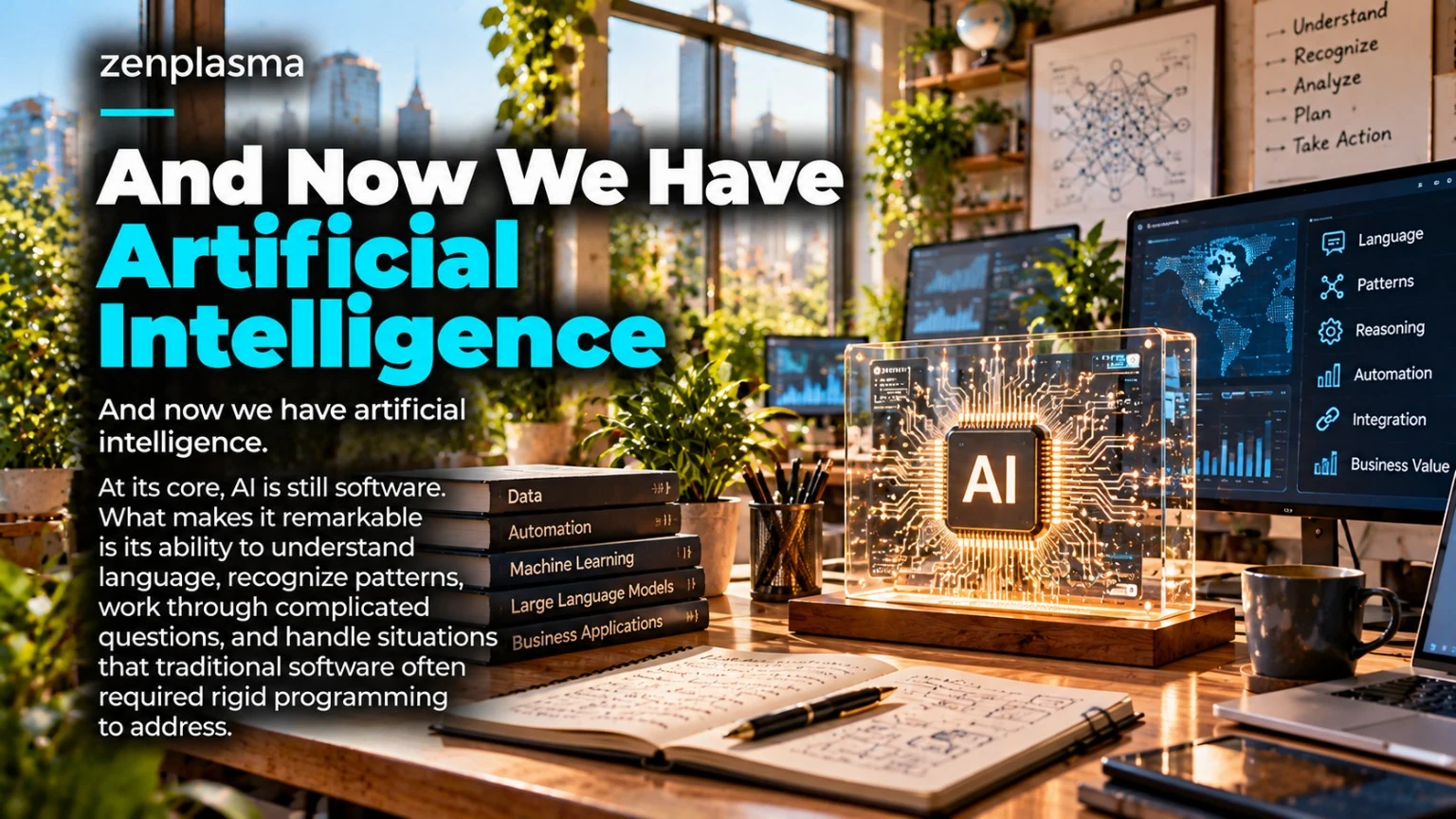
And now we have artificial intelligence.
At its core, AI is still software. What's remarkable is its ability to understand language, recognize patterns, and handle complicated questions that traditional software often required rigid programming to address.
Combined with existing business systems, these abilities represent another major evolution in what software can do.
A Practical Framework
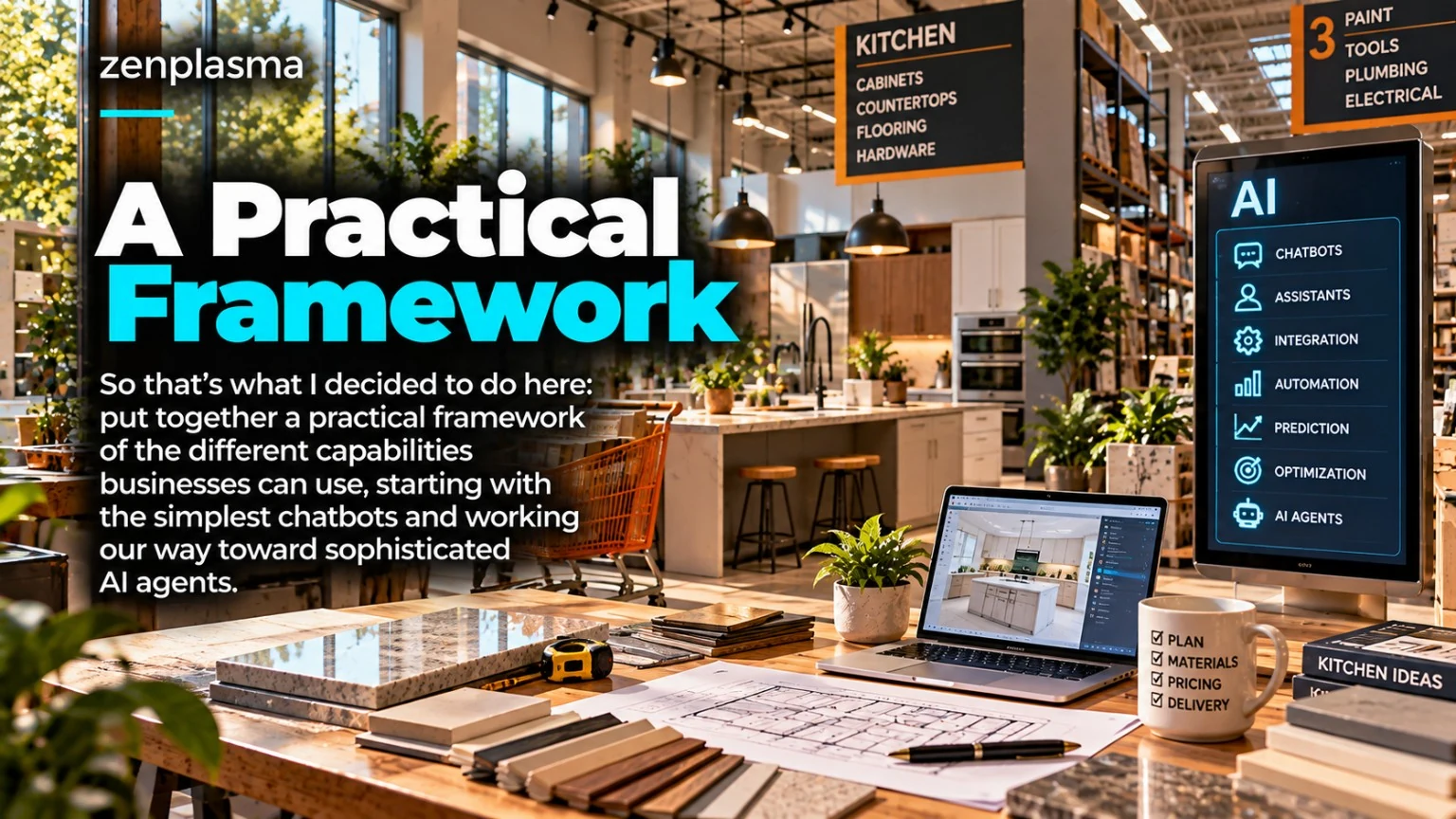
That's why I decided to put together a practical framework, starting with basic chatbots and working toward sophisticated AI agents. We'll also explore how these systems are implemented, because understanding what AI can do is only half the story.
Imagine a home improvement retailer with 30 stores. A customer is renovating a kitchen and needs help choosing materials, calculating quantities, checking prices, and arranging delivery.
We'll use that same situation to explore seven AI capabilities, plus one particularly interesting enhancement. Several can be combined depending on the company's needs.
Let's start with something almost everyone has encountered.
Level 1 — The Menu-Based Chatbot
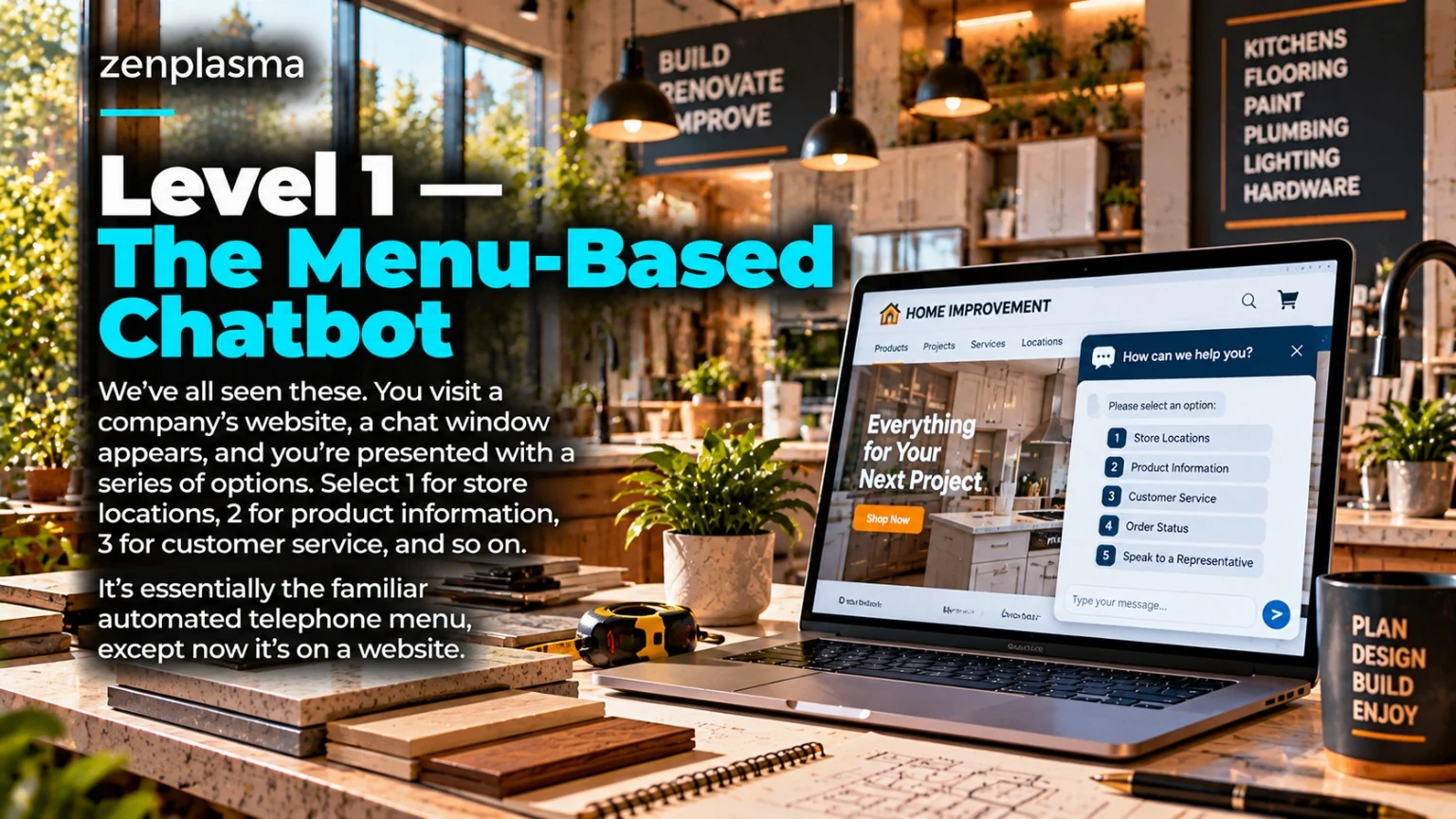
We’ve all seen these. You visit a company’s website, a chat window appears, and you’re presented with a series of options. Select 1 for store locations, 2 for product information, 3 for customer service, and so on.
It’s essentially the familiar automated telephone menu, except now it’s on a website.
In our home improvement store example, a customer planning a kitchen renovation might select the kitchen department, browse product categories, and find information about countertops or cabinet hardware.
It’s a simple way for businesses to organize information and help customers find what they need.
Implementation is relatively straightforward. The company identifies frequently asked questions, creates menu options, and connects each choice to the appropriate information or department. Platforms exist that make this possible without extensive programming.
For a retailer handling hundreds of inquiries every day, even this basic capability can be useful.
But suppose our customer doesn’t want to navigate menus. They simply want to ask a question and get an answer.
That’s where the next capability comes in.
Level 2 — The Information Chatbot
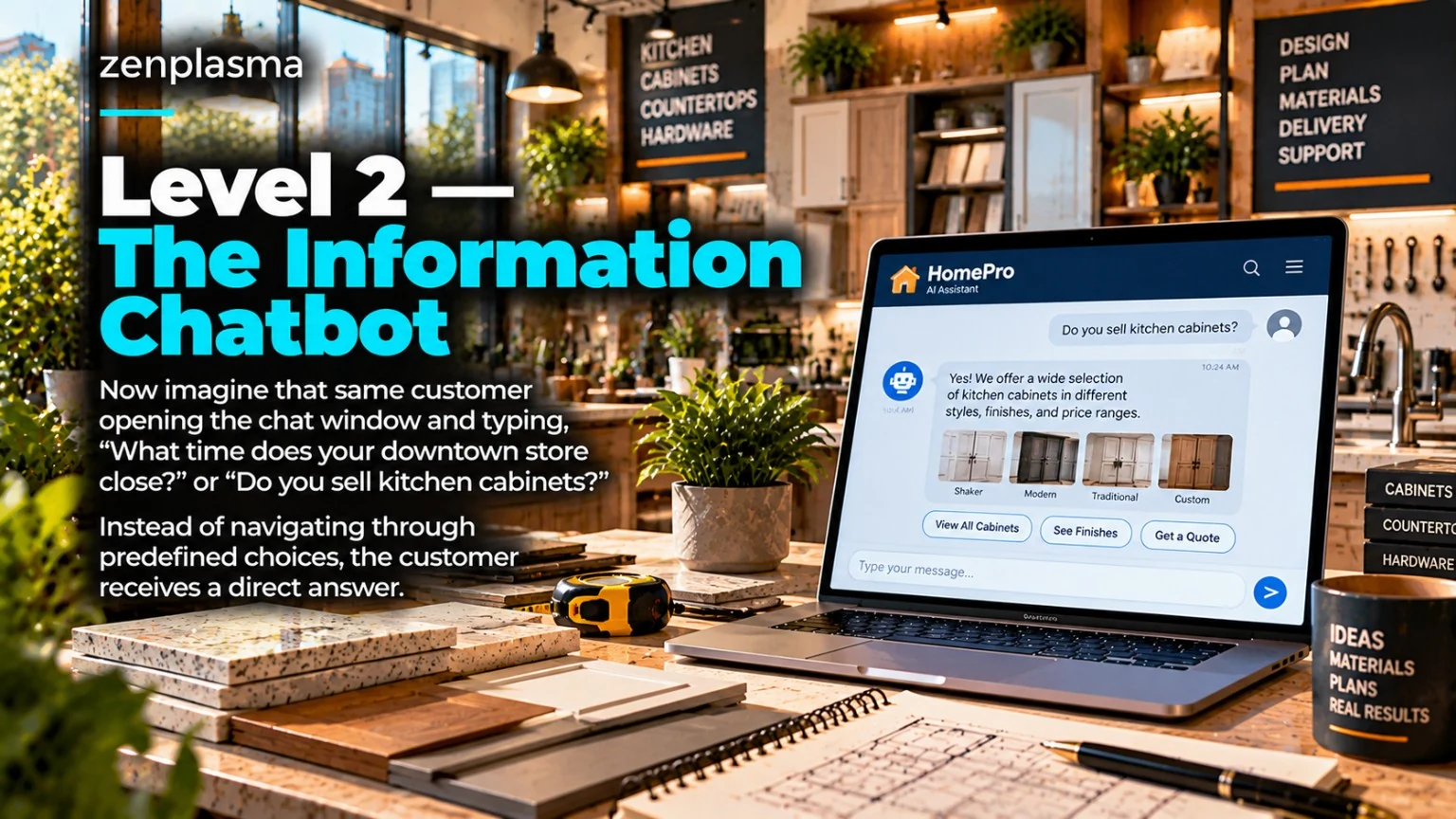
Now imagine that same customer opening the chat window and typing, “What time does your downtown store close?” or “Do you sell kitchen countertops?”
Instead of navigating through predefined choices, the customer receives a direct answer.
The chatbot can provide information about store locations, opening hours, product categories, return policies, and other routine questions. It’s a more convenient way to access information, especially for a retailer that receives the same inquiries over and over again.
So how does a company implement this?
It starts by gathering the information customers regularly need: frequently asked questions, store details, company policies, product categories, and other reference materials.
Depending on the platform, the company can organize these into predefined responses or use a system that identifies the customer’s question and retrieves the appropriate information.
The business can begin with a relatively small collection of answers and expand it as new questions arise.
Already, we’ve moved from making customers navigate a menu to letting them ask for information directly.
But now imagine our customer asks something more complicated.
“I’m renovating my kitchen. I’m thinking about quartz countertops, but I’m not sure whether they’re worth the extra money. And I want to replace the backsplash. What would you recommend?”
Suddenly, we’re having a very different kind of conversation.
Level 3 — Conversational AI
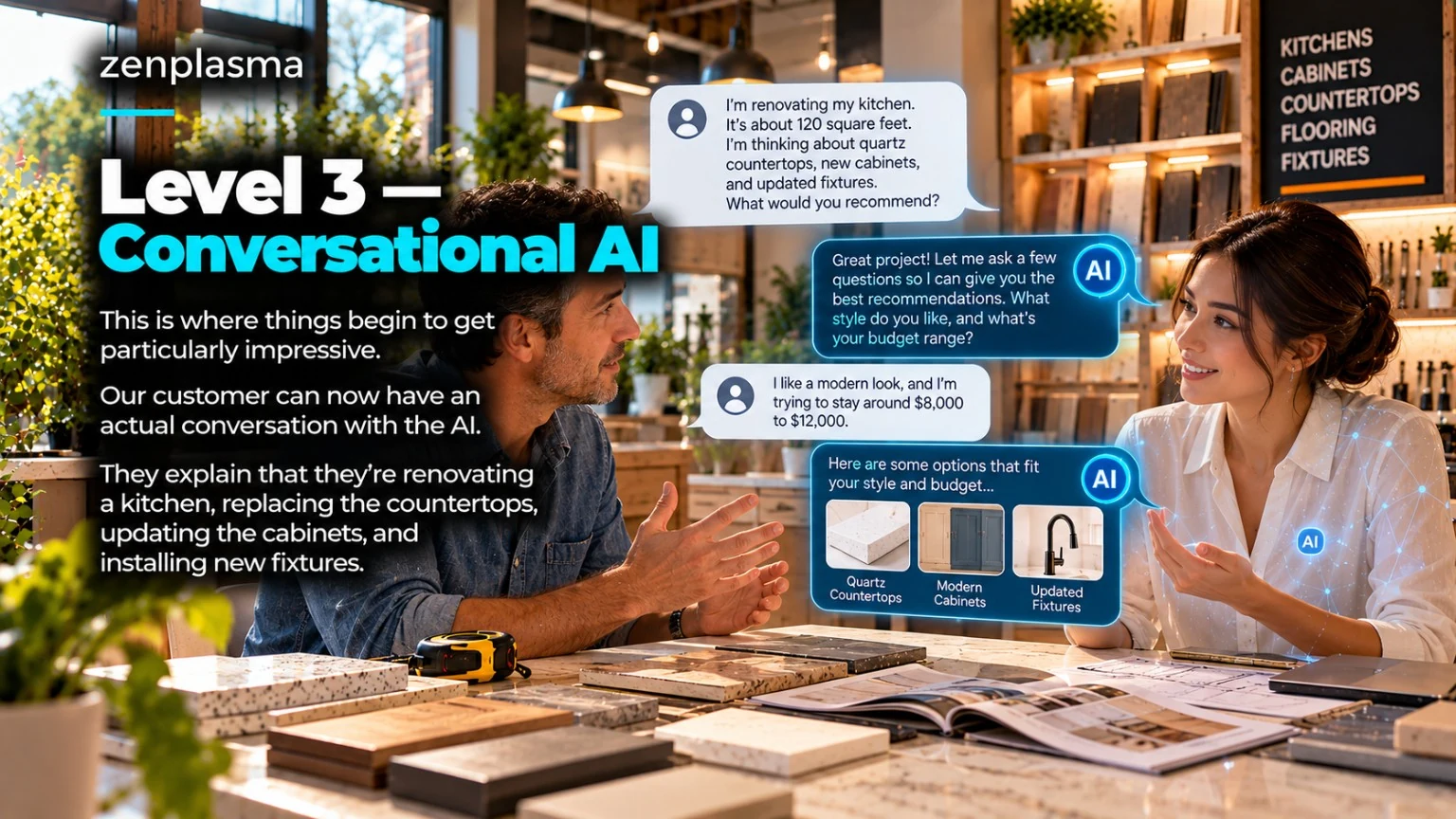
This is where things begin to get particularly impressive.
Our customer can now have an actual conversation with the AI.
They explain that they’re renovating a kitchen, replacing the countertops, updating the backsplash, and installing a new sink. The AI can ask questions about the room’s dimensions, discuss different materials, calculate approximate quantities, and recommend products based on the customer’s budget and preferences.
The customer might ask whether quartz countertops are worth the additional expense, which backsplash materials are easiest to clean, or how many tiles they’ll need. The AI can explain the trade-offs, offer alternatives, and help them make informed decisions.
And the customer doesn’t have to ask everything perfectly. They can change their mind, introduce new information, or ask follow-up questions, much as they would when speaking with a knowledgeable store employee.
For a home improvement retailer, this opens up fascinating possibilities.
Imagine offering customers detailed product assistance at any hour of the day, whether they’re shopping from home or standing in one of the company’s stores.
So how does a company implement conversational AI?
The business selects a conversational AI platform and provides the information the assistant needs, including product catalogs, technical guides, installation instructions, and company policies.
It then configures the assistant, tests it with realistic customer conversations, evaluates its answers, and refines its information and instructions.
But as I thought more about this, another possibility occurred to me.
What if we could take the experience of a company’s very best employees and make that available to the AI as well?
Level 3+ — When AI Gains the Experience of Your Best Employees
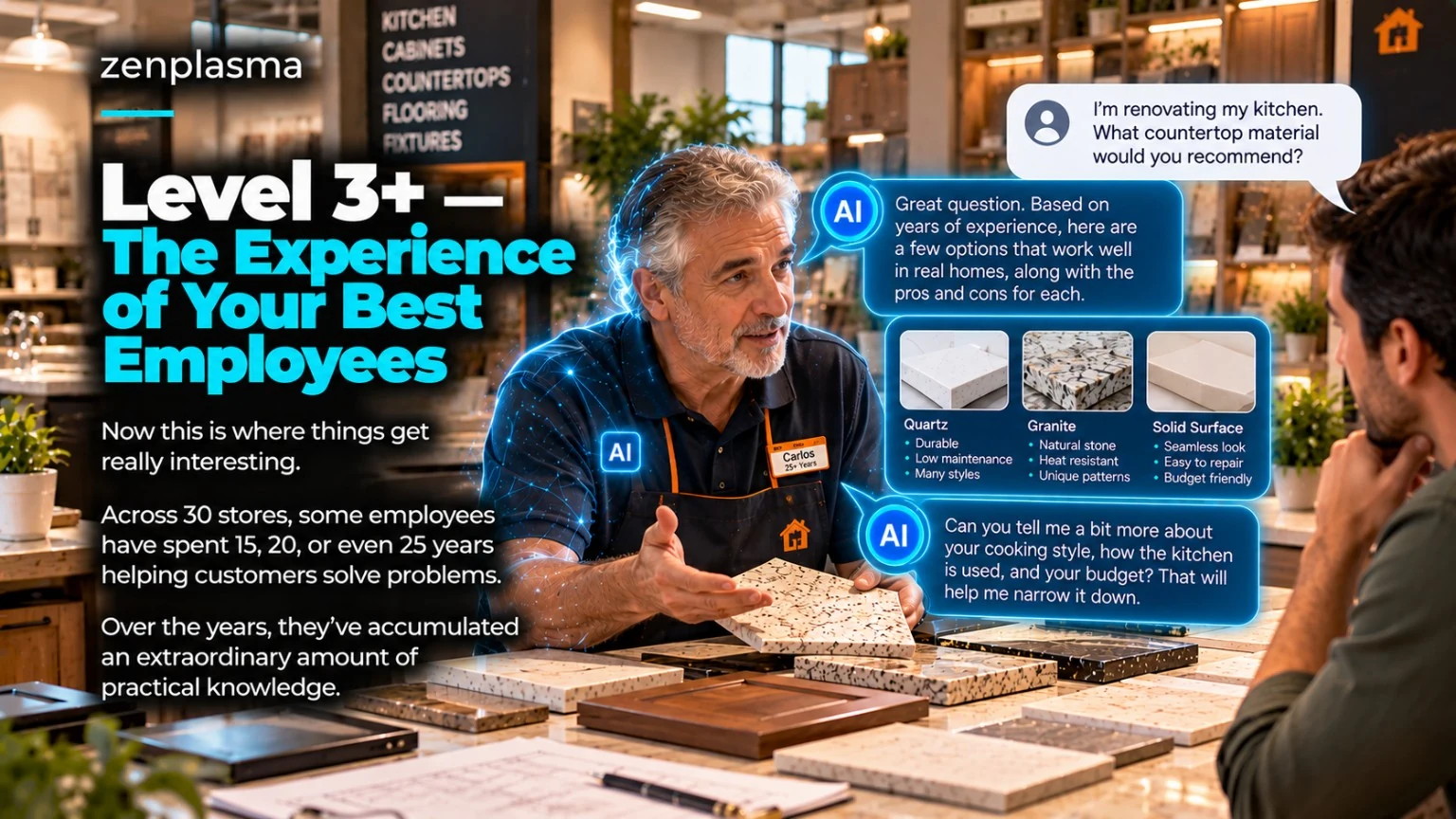
Now this is where things get really interesting.
Imagine our home improvement retailer has been operating for decades. Across its 30 stores, it has employees in practically every department who have developed 15, 20, or even 25 years of expertise helping customers solve all kinds of problems.
Over the years, these employees have accumulated extraordinary practical knowledge. They know which products hold up better, which mistakes customers repeatedly make, and when a less expensive solution might actually be the better choice.
And much of that knowledge isn't necessarily written down anywhere.
The veteran has encountered thousands of situations. They've seen products succeed and fail. They've learned from mistakes, solved unusual problems, and developed practical judgment through years of experience.
Now imagine capturing that experience and making it available to the company's AI assistants.
Let's return to our customer renovating a kitchen.
They mention that the paint on the wall behind their kitchen sink keeps peeling.
A capable conversational AI can recommend washable kitchen paint, explain surface preparation, and suggest suitable products.
But a veteran paint specialist might recognize something more. Perhaps water is splashing behind the sink, a slow leak is allowing moisture into the wall, or improper preparation keeps causing the paint to fail.
Instead of simply recommending another gallon of paint, an AI enriched with that experience could ask a few additional questions and help the customer identify the underlying problem.
So how would a company accomplish this?
The company interviews experienced specialists from every department, gathering their insights about common problems, product recommendations, customer mistakes, and lessons learned over the years.
Their experience becomes part of the AI's knowledge, which is then refined using realistic customer scenarios and feedback from those specialists.
Customers receive better guidance, newer employees gain access to valuable expertise, and the company preserves knowledge that might otherwise disappear when experienced employees retire.
For me, this is one of the most fascinating possibilities of business AI.
And so far, we've focused primarily on what the AI knows and how it communicates with customers.
Now imagine connecting that intelligence to the systems that actually run the business.
What if our customer could ask whether those backsplash tiles are in stock, how much they cost today, and which store has enough boxes to complete the renovation?
Level 4 — Connected AI: When Intelligence Meets the Business
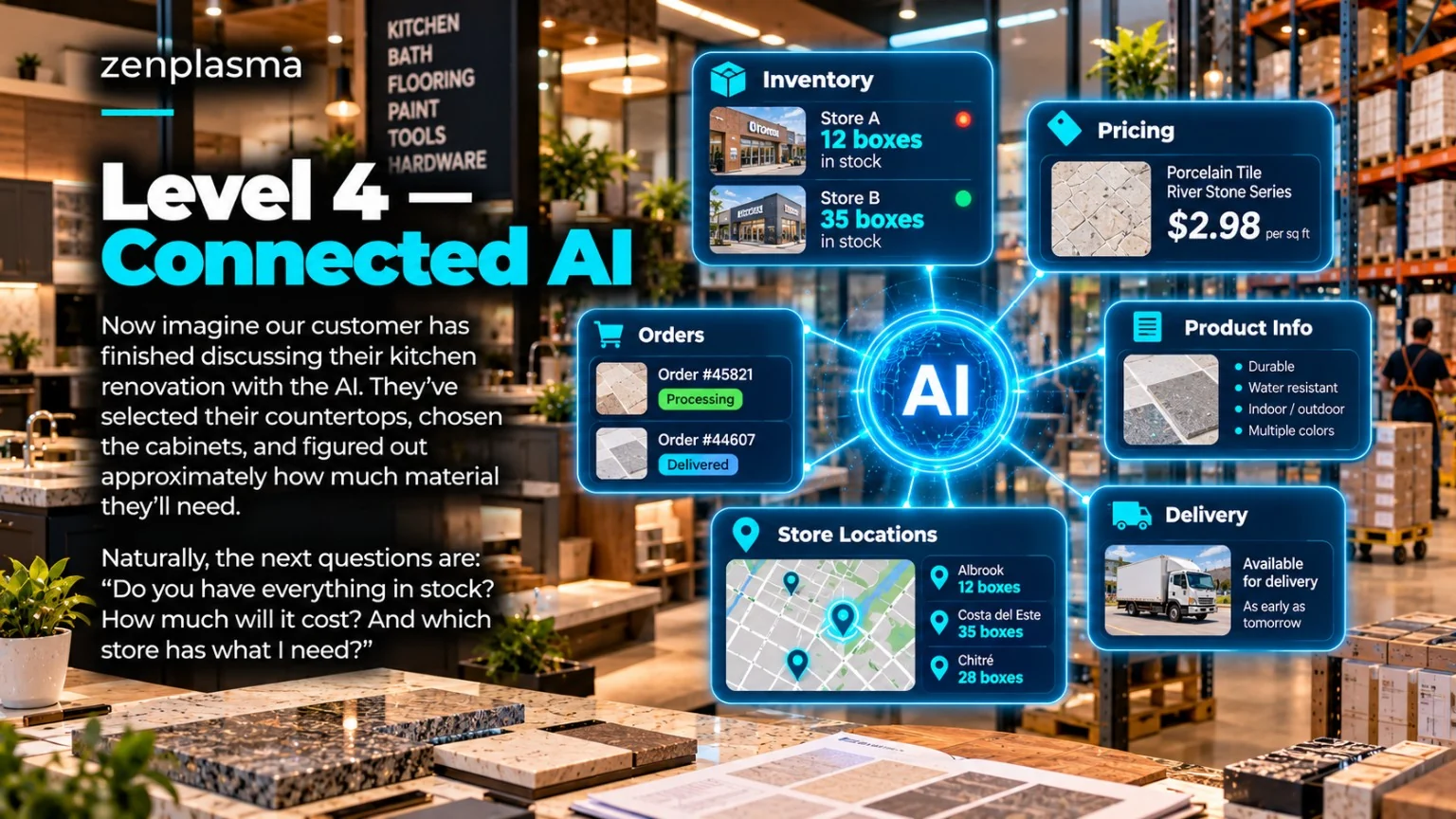
Now imagine our customer has finished discussing their kitchen renovation with the AI. They’ve selected their backsplash tiles, chosen the cabinet hardware, and figured out approximately how much material they’ll need.
Naturally, the next questions are: “Do you have everything in stock? How much will it cost? And which store has what I need?”
This is where connecting AI to the company’s business systems becomes incredibly valuable.
Remember those enterprise software platforms we discussed earlier, like SAP and Oracle? These are the kinds of systems companies use to manage inventory, pricing, purchasing, customer records, and other essential operations.
Now imagine giving our AI assistant secure access to the relevant information in those systems.
Instead of relying on a product catalog, the AI can check current inventory and prices.
Our customer asks for 20 boxes of backsplash tiles. The assistant checks availability and discovers that the nearest store has only 12 boxes, but another location has 35. It can explain the options, compare prices, and help the customer decide where to purchase the materials.
Depending on the systems connected, customers could also ask about existing orders, delivery status, previous purchases, or product availability across the entire chain.
So how does a business make this happen?
Developers create secure connections between the AI and the company’s existing software, often using something called an API. Think of an API as a controlled doorway that allows one software system to request information from another.
The company decides what information the AI can access, establishes the necessary permissions, and tests the connections to make sure customers receive accurate, up-to-date answers.
The AI doesn’t need to replace the company’s existing software. It can work with the systems the business already uses.
We’ve gone from an assistant that understands products and helps customers make decisions to one that can also tell them what’s actually happening inside the business.
But so far, our customer has been interacting with the AI through a website or chat window.
What if they could simply pick up the telephone and have that same conversation?
Level 5 — Inbound Voice AI: When Customers Can Simply Call
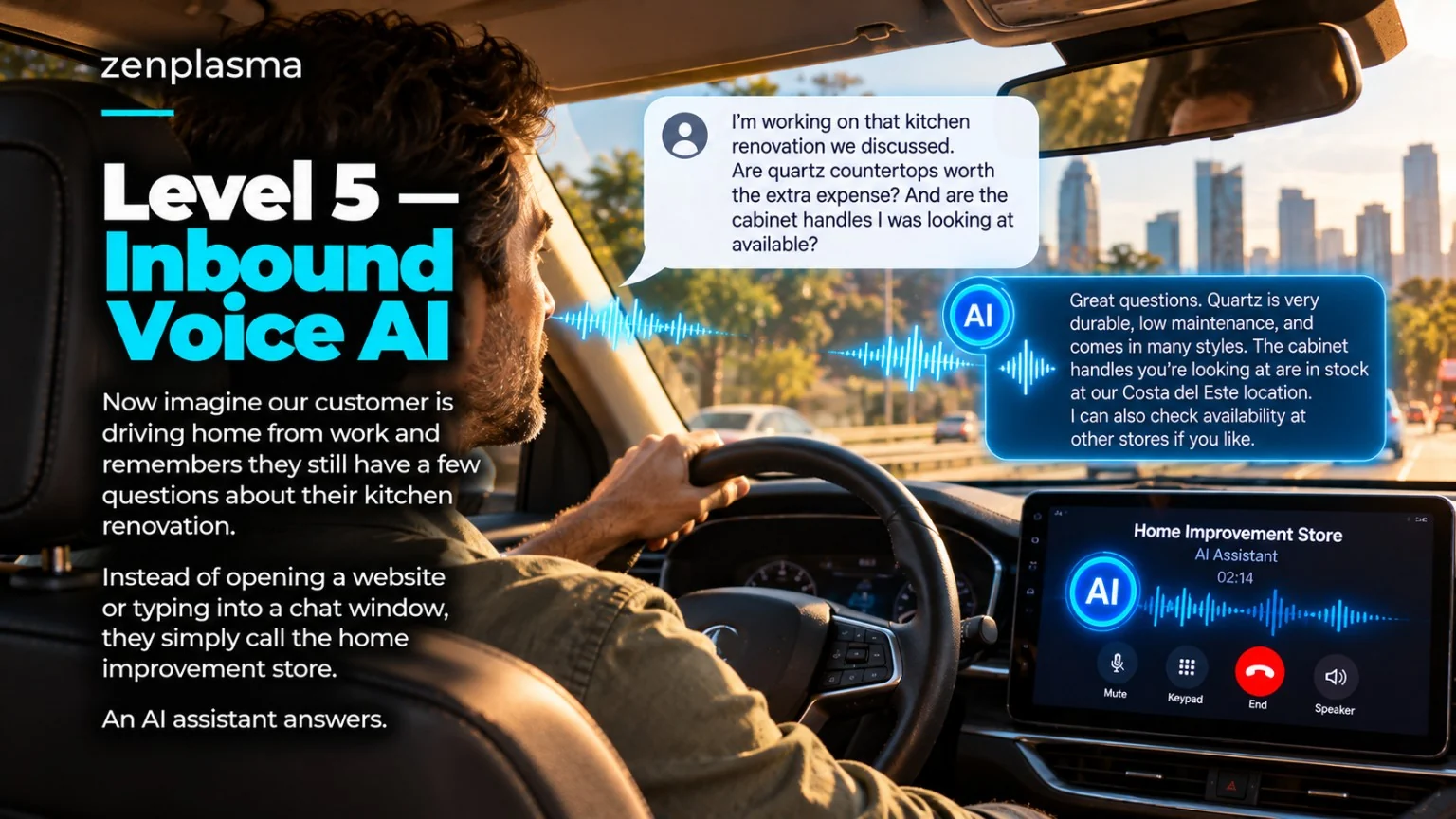
Now imagine our customer is driving home from work and remembers they still have a few questions about their kitchen renovation.
Instead of opening a website or typing into a chat window, they simply call the home improvement store.
An AI assistant answers.
The customer can speak naturally, just as they would with an employee.
“I’m working on that kitchen renovation we discussed. I was wondering whether I should use larger tiles for the backsplash, and I’d also like to know if the sink faucets I was looking at are available.”
The AI listens, understands the questions, and responds conversationally. It can discuss different backsplash tile sizes, explain installation considerations, and, if connected to the company’s inventory system, check whether those kitchen faucets are in stock.
The customer can interrupt, ask follow-up questions, change their mind, or introduce an entirely different topic. The conversation can flow naturally without navigating telephone menus or waiting for a particular department.
For a business receiving hundreds or thousands of calls, the possibilities are significant. Customers can get assistance outside regular business hours, routine inquiries can be handled without tying up employees, and more complicated situations can be transferred to the appropriate person.
So how does a company implement something like this?
The business connects a conversational AI system to a telephone service. Speech recognition converts the customer’s voice into information the AI can process, and voice-generation technology allows the assistant to respond naturally.
Much of this technology is already available through specialized platforms. The work involves configuring the assistant, connecting the telephone system, providing company information, and testing how it handles real conversations.
The intelligence behind the conversation can be the same intelligence we’ve already explored. The difference is that customers can now interact with it simply by speaking over the telephone.
But what if the company wants to take the initiative?
What if, instead of waiting for customers to call, the AI could actually call them?
Level 6 — Outbound Voice AI: When the Business Makes the Call
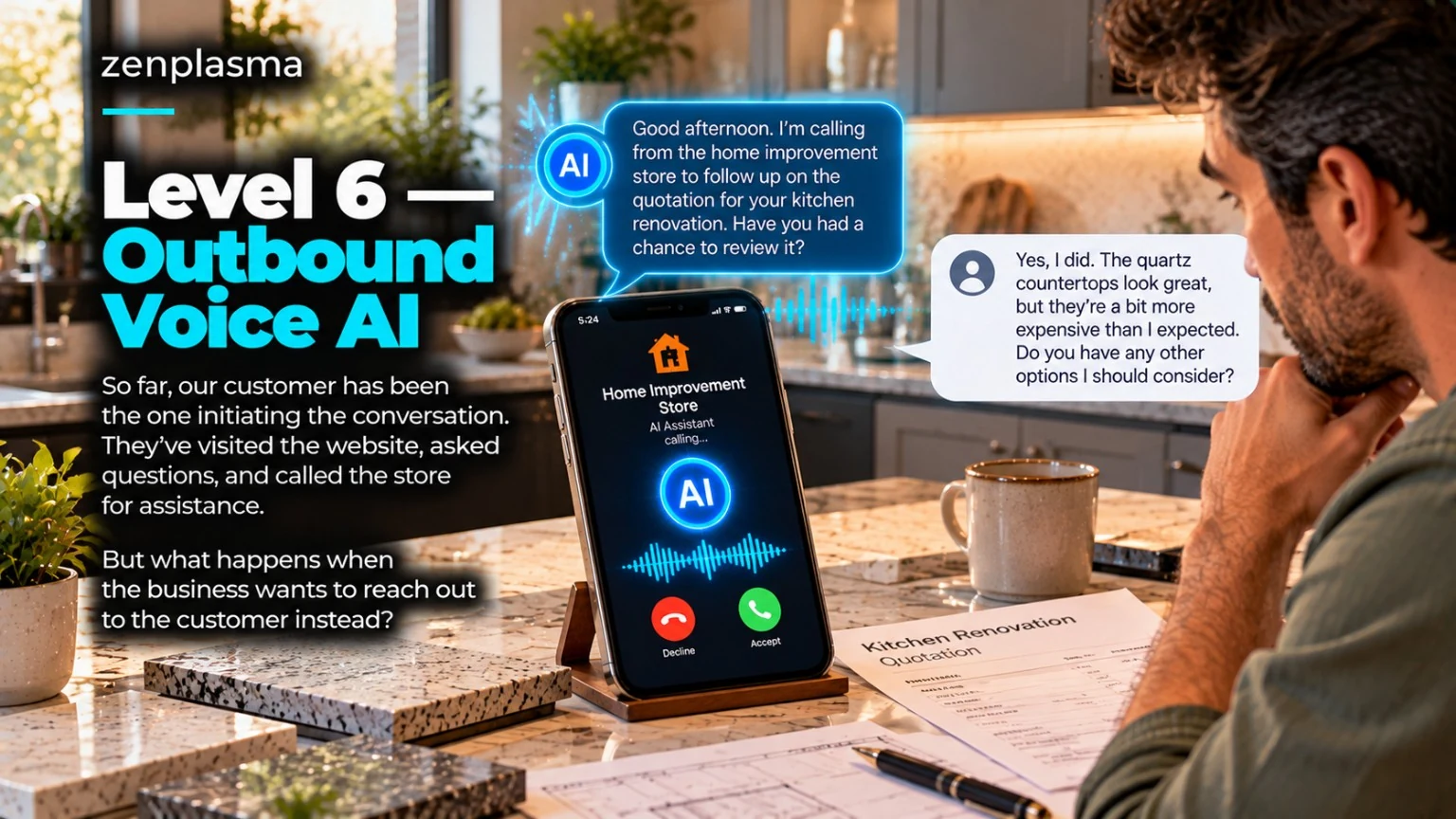
So far, our customer has been the one initiating the conversation. They’ve visited the website, asked questions, and called the store for assistance.
But what happens when the business wants to reach out to the customer instead?
Imagine our customer requested a quotation for their kitchen renovation but hasn’t made a purchasing decision yet.
A couple of days later, their phone rings.
“Good afternoon. I’m calling from the home improvement store to follow up on the quotation for your kitchen renovation. Have you had a chance to review it?”
It’s the company’s AI assistant.
The customer explains that the original countertop selection was more expensive than expected. The AI can discuss alternatives, answer questions, and, if connected to the company’s systems, reference the quotation and provide updated information.
Beyond sales follow-ups, outbound voice AI can confirm deliveries, remind customers about installations, follow up on service requests, or notify them when products become available.
For a retailer with 30 stores, that could eliminate a substantial amount of repetitive calling while maintaining consistent customer communication.
Implementation is similar to inbound voice AI. The company connects a conversational AI platform to a telephone service and establishes when calls should happen, who should receive them, and their purpose.
Calls can be triggered by events in the customer management system, such as pending quotations or upcoming deliveries. The business also defines calling rules, customer permissions, and procedures for transferring conversations to employees.
The result is an assistant capable of initiating useful conversations on the company’s behalf.
By now, our retailer has AI that can advise customers, draw on employee expertise, access live business information, and handle incoming and outgoing calls.
But there's one more possibility.
What if AI could go beyond conversations and actually coordinate the work required to complete a purchase?
Level 7 — Operational AI Agents: When AI Starts Getting Things Done
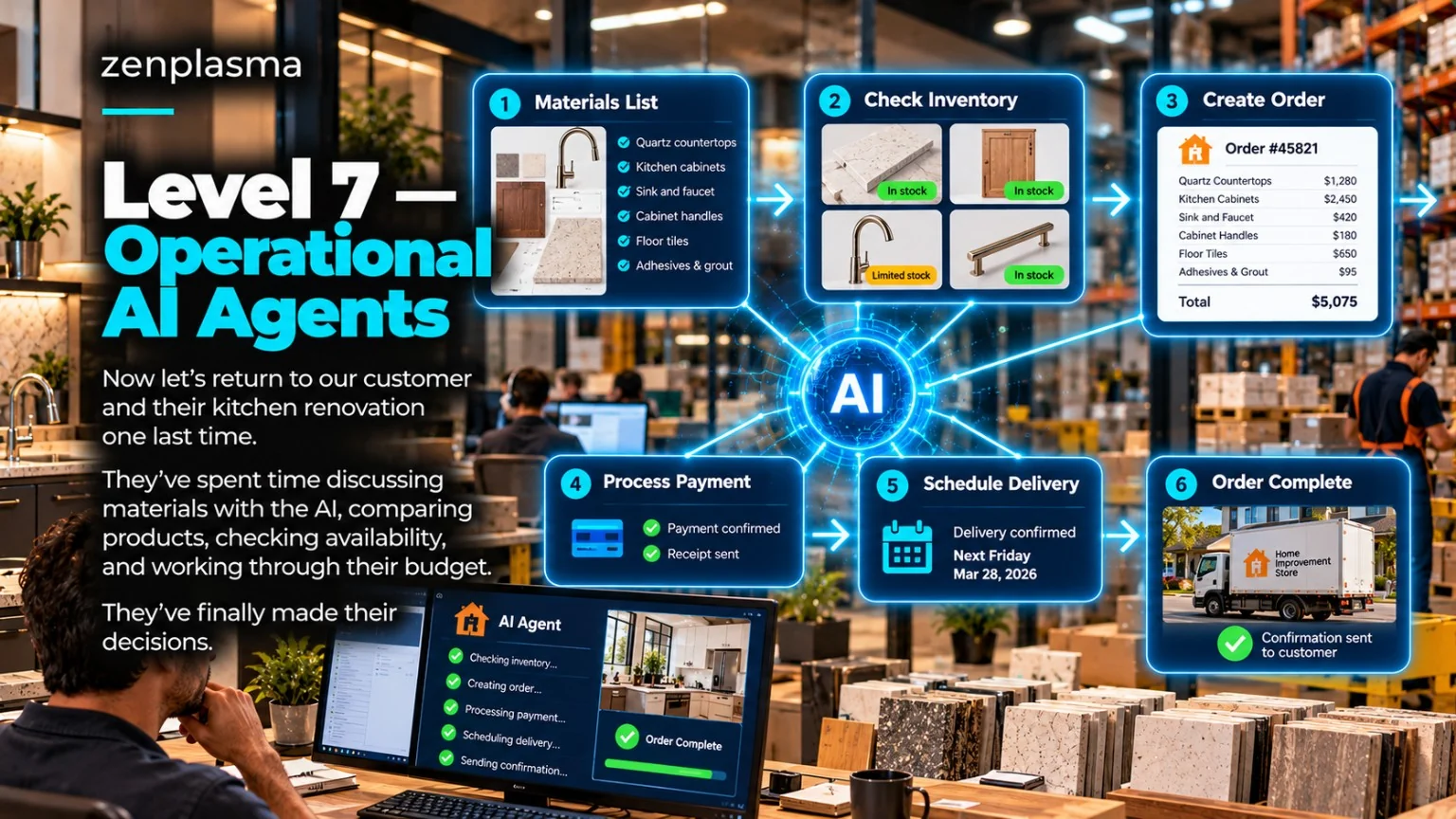
Now let’s return to our customer and their kitchen renovation one last time.
They’ve spent time discussing materials with the AI, comparing products, checking availability, and working through their budget.
They’ve finally made their decisions.
“I’ll take the backsplash tiles we discussed, the cabinet hardware, the kitchen faucet, and everything else on the materials list. Can you arrange the order and have everything delivered next Friday?”
Imagine the AI responding:
“Absolutely. Let me put everything together and check the delivery options.”
And then it actually starts doing the work.
The AI checks the materials list, verifies inventory, confirms prices, and prepares the order. When a faucet isn't available at the nearest store, it checks another location.
It presents the order for approval, coordinates payment, schedules delivery, and sends the customer a confirmation.
If something goes wrong, such as a delayed shipment, the AI can help resolve the situation or involve an employee.
This is the world of operational AI agents.
Instead of simply answering questions, the AI can carry out a sequence of business activities across different systems. An agent works toward a defined objective, uses connected software tools, and coordinates the steps needed to complete a task.
Beyond our kitchen example, agents can help process purchase orders, schedule appointments, coordinate deliveries, prepare reports, and manage routine administrative work.
So how does a business implement this?
It begins by identifying one specific process, such as turning an approved materials list into an order with scheduled delivery.
The company maps the steps, connects the necessary software systems, defines what the AI is authorized to do, and establishes where human approval is required.
Developers then test the workflow against realistic situations, including unavailable products, missing information, and unexpected problems.
A business doesn't need to automate everything at once. It can start with quotation preparation, expand into order creation, and eventually coordinate deliveries and customer follow-ups.
For our 30-store retailer, each additional capability can reduce repetitive work, improve consistency, and make purchasing easier for customers.
Human Resources in AI
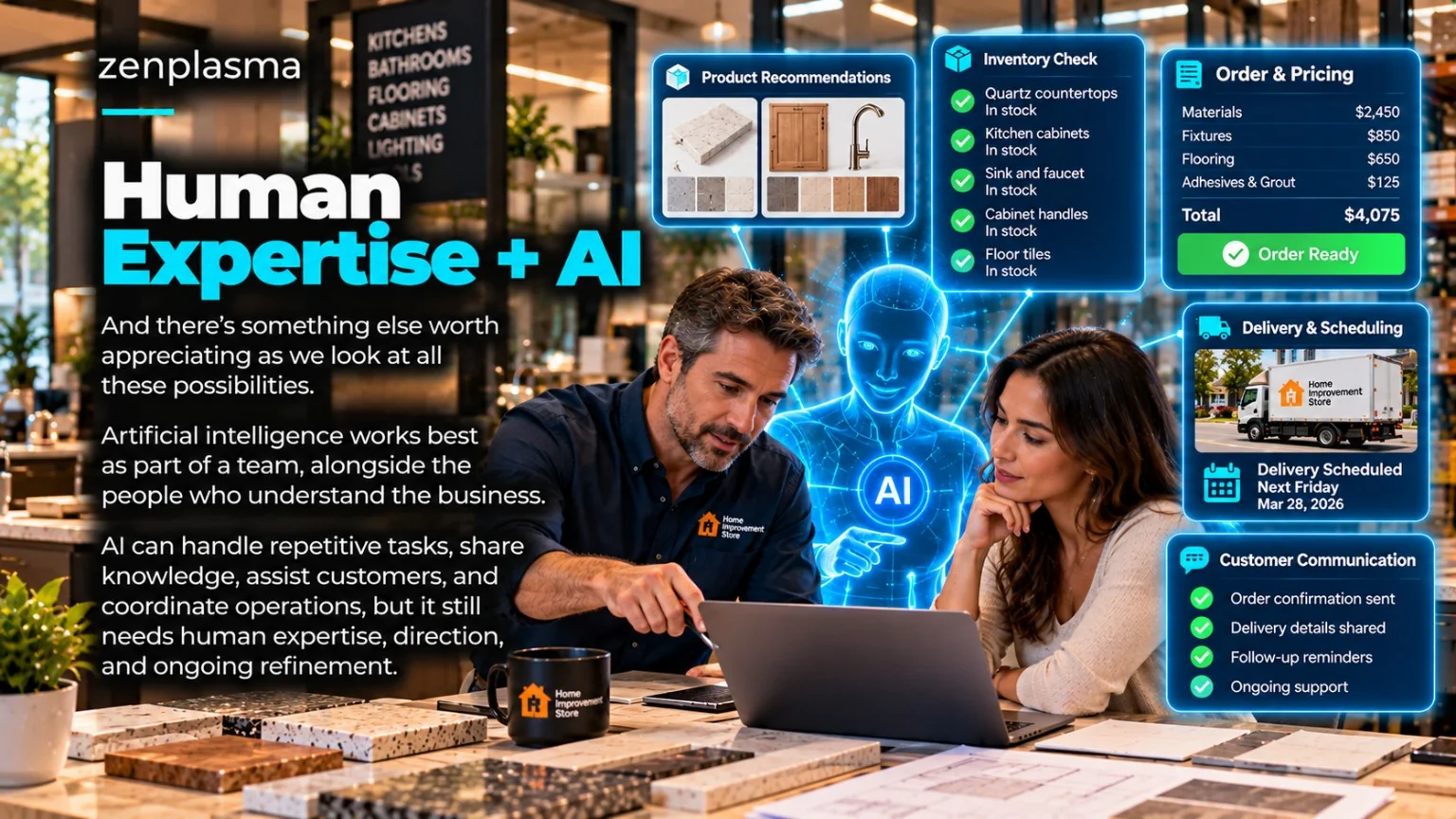
And there’s something else worth appreciating as we look at all these possibilities. Artificial intelligence works best alongside the people who understand the business.
AI can assist customers, share knowledge, and coordinate operations, but it still needs human expertise and direction.
Think back to our veteran employees. Their decades of experience make the AI far more valuable. And even sophisticated AI agents need people to define their objectives and guide their work.
When people bring their experience, creativity, and judgment together with the capabilities of AI, the entire organization becomes more effective.
The Bigger Picture
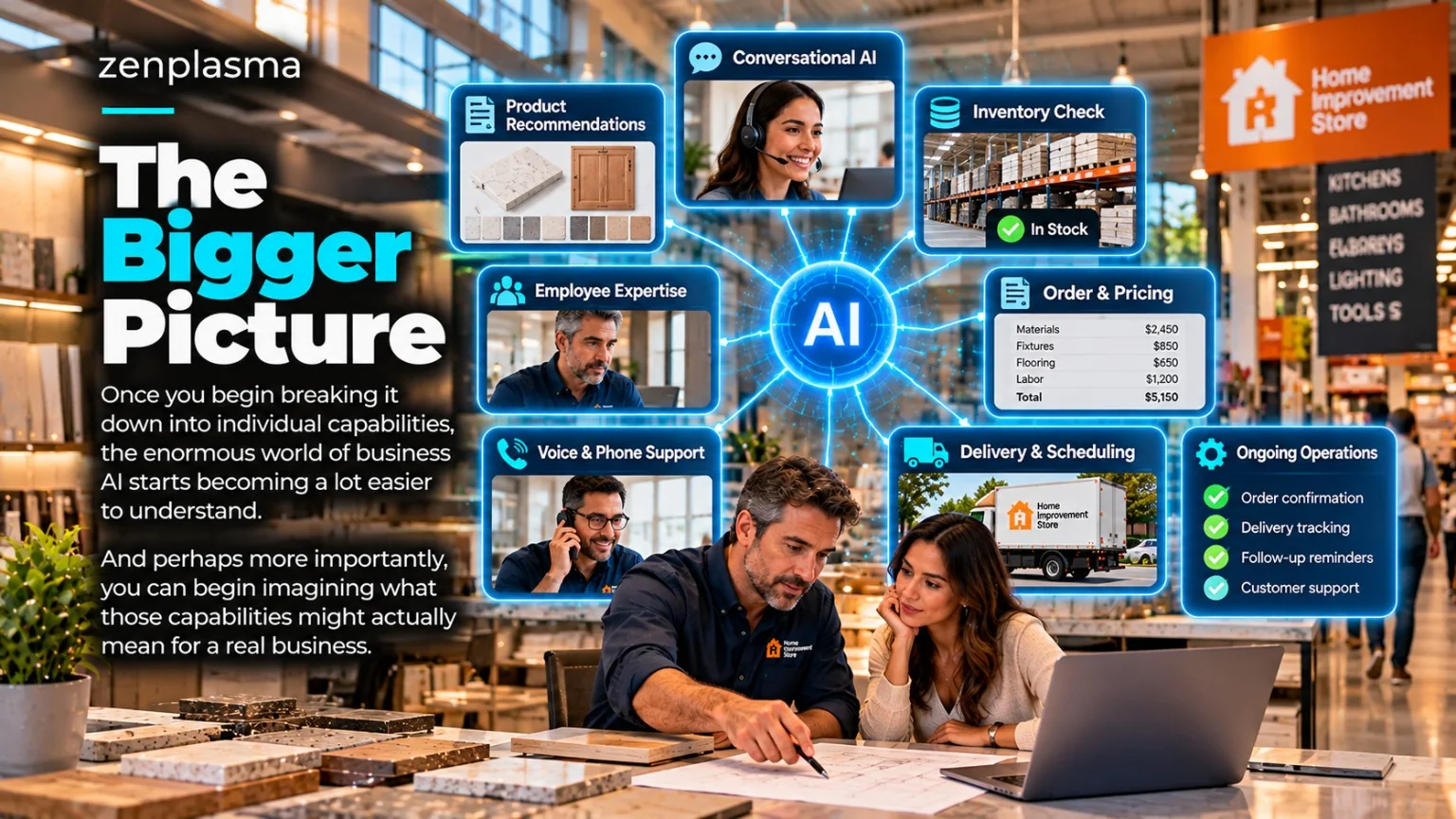
And when you look back at where we started, the progression is remarkable.
We began with a simple chatbot offering a handful of menu options.
Now we have AI that can understand complex requests, draw on employee expertise, access live information, handle telephone conversations, and coordinate business operations.
All built around something as ordinary as renovating a kitchen.
And that’s what fascinates me about this technology.
Once you break it down into individual capabilities, business AI becomes much easier to understand—and you can begin imagining what it might mean for a real business.
What’s Next?
When I first heard Valentina having that remarkable conversation, I knew I was witnessing something special. But I also realized how much I still had to learn about the technology behind it and what it could mean for businesses.
That’s really what inspired this article.
As I began exploring business AI, I found myself surrounded by technical terminology and seemingly endless possibilities. Breaking everything down into this framework has helped me tremendously, especially as I prepare to have more meaningful conversations with business owners.
And hopefully, it’s helped you too.
Of course, this has only been an overview. There’s still a great deal to explore. What does a company actually need to get started? Which technologies are involved? How much preparation is required? And what does it all cost?
Those are questions I intend to explore in future articles here on Zen Plasma.
And I want to be transparent about something: I’m still learning myself. As I dig deeper into the practical details, I’ll be documenting what I discover along the way.
So this article represents where I am today.
What began with a fascinating conversation with an AI assistant has turned into an exploration of an entirely new world of business possibilities.
And while I certainly have plenty left to learn, I now have something I didn’t have when I first heard Valentina.
A framework for understanding what’s possible, how the different capabilities fit together, and where to begin asking the right questions.
For me, that’s already been an extraordinary first step.
And I’m looking forward to discovering what comes next.